A revolution on the scale of Stone Age to Iron Age or greater?

In talking to my friend Matthias recently while staying with him in Luxembourg, I was thinking about the scale of change we are going through.  He was describing the approach his daughters take to learning.  His eldest daughter is only 11 and her sister 9 yet already they take learning into their own hands, practicing new languages using tutorials on the internet.  In a similar way, if my own children (some 4 and 9 years older) want to find out about something new they look it up on the internet, as most of us do.  Much of the learning for the younger generation is done through peers using social media.  Matthias was also telling me about a series of wonderful tutorials that are freely available from universities in the USA  that his eldest daughter was going to look at.  Teachers now suggest that they are more like facilitators helping kids to understand where to access knowledge rather than the providers of it.  If their facts or presentations are wrong then the kids will look it up on the internet and correct them.  I wonder if in the future, education will shift to be more self-directed rather than controlled by an educational establishment.  In fact, I think it is already happening, it’s just that the formal systems have not caught up with it yet.

My own generation has lived through the introduction of these profound changes, perhaps this is the continuing impact of the Pluto-Uranus opposite Saturn generation of the sixties which has taken social revolution to a whole new scale.  I remember being at school when the very first computers came out and my family buying a sinclair programmable calculator which took an age to do relatively simple sums.  Yet within years Casio were making sophisticated calculators which we were using in Maths lessons.  When I entered the world of work, computers had still not really arrived and electric typewriters and word processors were the norm.  The phenomenon of email began to take hold over my early years of work and I remember the first brick sized mobile phones.  Now companies are virtual, employees often work from home or in multiple locations etc.

I suspect Historians might look back in the future and see this period as one which involved a scale of change for humanity like potentially no other period before it.  There may be others, for instance when we finally set up colonies off the Earth, but, with the first man in space and on the moon having happened in the last fifty years perhaps the seeds of this have already been sown.  I think there are many areas which will change.  Education appears to be one which is already changing, as is social interaction and the way we do business, shop, watch video, access music.  In fact everywhere we look there is quite seismic change taking place.  Looking back on my own life, I find it hard to imagine what it was like before mobile phones, the internet et al.  I know I lived through such times, but even in such a relatively short period, it is difficult to remember or imagine.

I suspect that I am already a fossil compared to the younger generation that have grown up immersed in this new world and cannot remember a time before the internet.  Before I pop off though, it is going to be interesting to watch how the next few steps evolve.

Leave a comment

Filed under On Life the Universe and Everything

Self Righteousness – am I the only one who can see this??

In my last blog a few days ago, I was alluding to self-rigtheousness and our need for a sense of humour in this regard.  This is something I have been giving thought to over the last few months and it cropped up again this evening in a conversation with my friend and colleague as we were dining together.  In watching Have I Got News For You recently following the death of Maggie Thatcher and with public attention on her funeral and legacy, I was horrified by the tone.  The whole programme was devoted to vitriolic attacks on almost everyone and everything including Margaret Thatcher.

Self-righteousness and it’s bedfellow hypocrisy seem to be topics which are particular favourites of ours as human beings.  We all seem prey to this and it produces some pretty horrendous results.  We poke fun quite cruelly and incredulously at what we see as other people’s hypocrisy, safe in the knowledge that we would never suffer from such weaknesses.  How do we get away with such hypocrisy?  Jonathan Haidt describes this brilliantly in his book The Happiness Hypothesis where he uses the analogy of a small human rider sitting on top of an elephant.  The elephant, he says, is the mammal brain – sophisticated, millions of years old and operating almost exclusively unconsciously.  Atop this sits the rational brain, like a small human rider; this brain is only thousands of years old, but it is convinced that it is running the show and making decisions.  In reality, the elephant is making all the decisions – imagine a small human rider trying to control an elephant should it decide it is going to move in a particular direction…

However, as Haidt points out, the rational brain wants to maintain the illusion that it is in control and running the show so it indulges in rationalisation and justification to maintain this illusion.  Haidt’s point was that this creates the sense for all of us that we are the only rational being in a sea of irrationality.  We can see the way that other people act on jealousy, fear, anger, competition; the ways in which they are hypocritical or corrupt but we cannot see this in ourselves (other people can see it in us but we are blind to it).  What Haidt challenges us to see is that the role of the rational brain is actually to turn it’s conscious awareness on ourselves and that it is only through this that we can truly “tame” or influence our elephant.  I recognise that self-righteousness is a step on the way to self-development, in that seeing things in others is at least part of the stage of recognising it in ourselves.  What appalls me is that other people cannot see their own self-righteousness and hypocrisy when it is so glaringly obvious, what idiots………..oh dear!

In discussing this this evening with my friend, we were discussing the topic of bankers.  My colleague felt there was a line that he would not transgress and that what saddened him was that they did not even see the anger people felt but dismissed it as jealousy.  I was suggesting that I could understand how they would feel like that and that, in our case, since we both ran training and coaching businesses which had as clients, banks and professional advsiors who had profited from banks we were complicit.  I was arguing that I could see it was a matter of scale – we might think nothing of not correcting a petty amount of money or paying someone in cash on the odd occasion without seeing ourselves as being corrupt, yet if our actions were subject to the scrutiny of the media and spun in the right way we could easily be accused of being corrupt materialists out for ends.  He could not help but smile and agree at the fact that the temptation was there to fiddle the expenses slightly for clients who had messed us around, or taken advantage of us and that we have to challenge ourselves at times to think “would we be happy to be charged this”  to prevent us unconsciously justifiying these temptations.  Somehow though, in our minds, our deviations from our good intentions are small justifiable affairs; we are convinced we are intrinsically good.  The more we got into the argument the more it emerged how easy it is, if we identify with being good, to feel that our actions are different, that others simply aren’t motivated by the same quality of “goodness” that we are.  In the end he accepted the point I was making (difficult to do otherwise as he was arguing on his unconscious emotions and I don’t suffer from competition and self-righteousness) but challenged me by asking how we then deal with the dangerous actions of others; he felt we had to draw a line.  This reminded me of a hexagram I had recently thrown in the I-Ching – 61 Inner Truth which says:

Thus the superior man, when obliged to 
judge the mistakes of men, tries to penetrate their minds with understanding, 
in order to gain a sympathetic appreciation of the circumstances. In ancient 
China, the entire administration of justice was guided by this principle. A 
deep understanding that knows how to pardon was considered the highest 
form of justice. This system was not without success, for its aim was to make 
so strong a moral impression that there was no reason to fear abuse of such 
mildness. For it sprang not from weakness but from a superior clarity.

I was struck by the fact that we need to deal with such corruptions and hold people accountable at times, but if we are aware of our own fallibility it does not mean we do not act but allows us to do so with compassion and understanding rather than self-righteous judgement and moral pomposity.  In watching Having I Got News For You and the vitriol poured out towards someone who had died (Margaret Thatcher), the lack of humanity was deeply saddening and shocking for me, yet, whilst I might be saddened and not wish to condone the lack of humanity, I could not but help recognise that in my late-teens I felt exactly the same way and at the time of the IRA bombing remarked to my then girlfriend that I wished they had succeeded in killing Maggie.  Her disgust at my comment made me feel more ashamed of myself than I think I have ever felt since.  I still wince now to think I could have been so heartless and inhuman, whether I liked someone or not.

If my friend Chrissy’s model of the brain is correct (and the evidence from the New Scientist seems to support it more and more strongly) then the rational brain (or pre-fontal lobes) is represented by Uranus (Aquarius) and Saturn (Capricorn) and these in turn correlate to the top lines of Hexagram 1 (The Creative) and Hexagram 2 (The Receptive).  Given the dangers of self-righteousness and judgmental enforcement of rules without “penetrating their minds with understanding”, perhaps this is why the I-Ching provides such strong warnings in these lines.  For Aquarius:

Arrogant dragon will have cause to repent.

When a man seeks to climb so high that he loses touch with the rest of 
mankind, he becomes isolated, and this necessarily leads to failure.

for Capricorn:

Dragons fight in the meadow.
Their blood is black and yellow.

In the top place the dark element should yield to the light. If it attempts to 
maintain a position to which it is not entitled and to rule instead of serving, 
it draws down upon itself the anger of the strong.

Lastly, I can only say that I am glad, having understood all this, that it has freed me from ever falling prey to hypocrisy and self-righteousness as so many other less enlightened people seem to do.

Leave a comment

Filed under On Life the Universe and Everything

Who debunks the debunkers?

Watching TED talks yesterday evening, I came across a talk by someone called Michael Shermer.  He is the publisher of Skeptic magazine and he was illustrating the way that people are taken in by people claiming knowledge or products that do amazing things when there is no scientific evidence to support them.  He illustrated this by bringing along a device which claimed to be a modern dowsing device for detecting whether students had cannabis in their lockers.  This device cost $900.  He pointed out that if you go to enough student lockers you will find cannabis, so that the device is bound to work on some occasions.  He went on to say that it is the times that it doesn’t work that are critical and he and people like him are out to count these and debunk these myths.  So his point was that in examining sweeping claims we need to be very careful to look at the detail to ensure that we actually weigh and sift the facts to ascertain whether grand claims are accurate.  What was surprising was that he went on to say that this is the way that psychics and astrologers work – but that they were there to count the times it does not work.  Now, this is a very grand and sweeping statement.  Applying Michael’s own methods of skepticism, I would like to understand where the factual data lies to make such a sweeping statement.  There might be one or two cases where Michael might be accurate with this statement but, following his methods, I would like to count the times where this is not the case before taking such a grandiose claim at face value.  He is right we must be careful when people make large claims based on untested beliefs and he is also right to assert that it pays to be skeptical.  These people who make such claims with little evidence or direct research to back them up should be debunked.  So I would like to ask – who is going to debunk the grandiose and sweeping claims made by debunkers?  Whether astrology is true (personally I find it difficult to disbelieve given the overwhelming data I have that suggests it is accurate but I may be deluded) or not is not the point.  The point is that we cannot have double-standards.  Either we really do keep our statements accurate and factual (which means we are careful to acknowledge how little we know for certain) or we accept that we do not, but then we cannot accuse others of being inaccurate.  When I described this to my friend Sam this morning, he pointed out that I was lumping all debunkers in together in a sweeping generalisation – damn!  I think we had all better have a very good sense of humour about how we are all hoist by our own petards otherwise our self-righteousness is going to explode in our faces.

3 Comments

Filed under On Life the Universe and Everything

Further thoughts on Chiron from Sam

My friend Sam, a fellow student of Chrissy’s, wrote to me after reading my blog on Chiron so he is going to be my guest blogger and here are his thoughts on Chiron.  If Chrissy is right (which I think she is) and Chiron rules Virgo then Chiron/Neptune is the Pisces/Virgo axis of boundless and discrete – the comsos and the individual (ever ailing and dying) body.


Chiron/Neptune

 There are two forces in the universe, two ways of approach to life

 We are separate

 Or

 We are one

In the Tao te ching Lao Tsu says

All problems come from having a body.

Our body is separate, discrete, individual.

Our consciousness rooted in our physical brains also feels separate and individual

Yet we can sometimes feel that we are more; that our identity can dissolve and we are one with all things

This is the contrary pulling we experience.

We protect our bodies, our boundaries, our time, our property, our reputation.

But this work is never over.  As soon as a house is built nature starts pulling it down with rain from above, damp from below, insects, fungus and living things banging and battering from all around.

This is the way with everything we do and often we feel the opposing forces of the world are so strong we must fight to the death; some may use a philosophy for survival.  There is a useful rhyme in the film Cloud Atlas:


The weak are meat

And the strong do eat.


This is how we view the vegetation and animals of the world.  This is how we view other people when we fight wars or legalise slavery or take from another because we can.

Yet, we may sometimes imagine ourselves into the skin of another life, big or small, from a human to a microbe, that also fights for the integrity of its being.

This may shake our conviction.  It is hard to take the life of something once you feel its beating will to live is the same as your own. You may feel that you love this thing as yourself.

Next is another complication.  You realise that if neither of you kills then both will starve.  The chain of being is the food chain.

If you follow the links in this chain you see that the whole thing is a way of mixing atoms up into new combinations.  It’s a game of simultaneous killing and co-operation.

This leaves us in an awkward situation.  Whether we kill or be killed we are doing our job for the universe.  Yet, as conscious beings aware of the struggling individuality of all bodies, we don’t want to kill or be killed.

So, our separateness and our love for all things gives us a holy conundrum.

We may find some horrid problems as we work this out.  We all read or hear harrowing stories.  Many people experience these things sometime in their lives.

If you are a social worker, policeman or nurse you may come across, for example, a young baby cold, hungry and dehydrated covered in shit and cigarette burns.  You may find later the baby has cracked ribs, broken limbs and brain damage and will live a life of otherness.

You may open your eyes one day and find that you are the person who has done this to their child.  Or you may be the child living your life with this inheritance.

Everyone will have some story that is unbearable for them to contemplate; that makes them unable to feel love or union.  They may feel angry as Bob Dylan:

You who philosophise disgrace

And criticise all fears

Bury the rag most deep in your face

For now is the time for your tears.


What can be done with this?  You may strengthen your barricades and gather your weapons to attack the strong who harm the weak.

Yet still, your imagination and empathy may get the better of you and put you unexpectedly into the skin of the abuser.  You may feel their weakness and struggle for strength. Or you may notice yourself taking from another because you can. Or remember a moment you came close to doing something unforgiveable. You may feel you have actually done the unforgiveable.

Clearly our hearts cry out to protect the weak and we must be strong to do this.  But every so often we feel a sympathy, an understanding for the strong we are fighting against.

It is very awkward.  Are we separate or are we one?

But put your imagination back to the weak and innocent.  How would it feel to be the babies tortured and killed by their parents; the children starving around the world; the diseased everywhere; the animals living nasty, caged lives; the caterpillars eaten alive by the wasp lavae and countless other brutal examples from the natural world: all of the creatures suffering without the adequatio to take consolation from philosophy, simply suffering moment to moment till death?

It is hard to be in those skins.  We jump straight back out.  But we can’t forget them or put them behind walls where we can’t see them.  We return over and over to stories, books, films, news reports, conversations.  We know the ocean of suffering is there.  We look over the coast defences and wish we could forget the safety of our bodies and jump in.

And if you did what would you do?  Best wait till you know what you are doing. The news will be on in a minute. The authorities should be doing something about it anyway.  That includes God. How can cancer and parasitic worms be right?

To be separate or to be one is quite a problem.

Is it viable to balance in the middle?  Take an impersonal view of oneself and others as protagonists in the food chain of life while keeping ones heart open to the subjective feelings of all?

What would that be like?

2 Comments

Filed under On Life the Universe and Everything

In defence of Chiron (reprieved)

Having received a response to the blog I wrote a while back – In Defence of Chiron – from Clare which I have included below I am using (abusing?) my privilege of writing this blog to respond (Clare please feel free to respond and add any further thoughts and thanks for this thoughtful response).

I have been thinking about this for a day or two. Whilst you make a great point about vuulnerability being necessary in relationships, I think all the stories you quote above actually do show an innocent victim and a level of unnecessary suffering. What about Tess I cry? There is no redemption for her, she tries to defend herself against an overwhelming tide of cruelty and prejudice, and in the end there is no way out for her. The same for various characters in the other stories. I guess I am trying to define how we view myth. I think you can read it as an moral fable, and find purpose (it all works out in the end), or as tales of the very flawed gods and the necessity for us as human to use our consciousness to mediate the conflicted energies which they represent. The first is really a monotheistic reading (there is meaning, ‘god’ behind all this), the second is a more polytheistic, pagan view, where the energies are often in flux and unbalanced, hence cruelty can result. as Chiron is currently transitting my MC, along with Neptune, I am musing a lot on these things lately 🙂

This is an interesting response .  I have Chiron and Neptune squaring my Mercury in the 12th House at the moment so like Clare I am musing about these issues and experiencing them.  There have been a number of situations in my life giving rise to or prompting this thinking.  My father, having been a very robust and quite abnormally healthy man all his life has hit 77 (78 next month) and crashed.  This crash has been taking place over the last 18 months as Pluto has squared his Mars in Libra and Uranus has opposed it.  At the same time his natal Sun-Chiron in Gemini square Neptune in Virgo and Saturn in Pisces is also now being transited by Jupiter and Chiron.  The result has been what the psychiatrists describe as an agitated depression with delusions.  In addition to this, I have started working with a charity going into prisons to coach young offenders.

In terms of innocent victims and unnecessary suffering, I guess it depends on how you view “unnecessary” suffering.  Certainly I agree fully that life is cruel (from our heart’s perspective), how could we view it otherwise?  It is very sad for me to watch my father suffering.  He really is in a very bad state.  It is putting a huge burden on my mother who feels trapped so she is suffering too.  Yes, I think this is cruel from our human point of view.  Indeed, when I look around, much of nature seems cruel.  Animals eat each other, people are killed by natural disasters and so on.  Humans also do appalling things to other humans, very cruel things.  I’m with Clare, I don’t like much of it, it hurts my heart.

With astrology we seem to have a unique system which accurately describes a pattern of archetypal energies at play (some call these gods, some angels and so on).  At the moment with Neptune square my Mercury in Sagittarius, I am expecting delays and confusions with regard to travel and communication.  I am writing this on the Eurostar to Paris after a two and a half hour delay on my train into London.  It was a series of delays with much confusion and it wasn’t possible to contact anyone because there was no signal for mobile phones.  As I mentioned in a recent blog, the more I work with astrology (I was first introduced to it when I was about thirteen years old), the more I realise it is describing very accurately the energies at play around us.  At the same time, it is unusual in being a system that provides a framework which exists independent of individual interpretation.  Personally I’m not convinced about attributing events in our current lives to past lives.  I don’t know whether there is such a thing as past lives; I am keeping an open mind on this.  However, it feels like a justification for the fact that some of the awful things that happen to people don’t feel fair so we extend their lives to say that they must have deserved it at some point, this seems an old crime and punishment type of view but then I could be wrong.

So, where are we with this one?  If we have a framework that tells us that there are energies at play in a specific pattern which plays out through and around us, then it is built into the system – I am not sure if this is a monotheistic viewpoint, because I am not sure I believe in a god, or gods.  My friend Chrissy suggested recently in thinking about the I-Ching that life may be like a mathematical model or system, which would explain why the I-Ching works and astrology because they reflect this inherent model.  At the same time, in consulting something like the I-Ching, we are then consulting the accumulated wisdom of human beings who have encountered and interpreted the particular points in this system.  In the same way, as astrologers, we are building a composite body of knowledge about the planets and transits which will contribute to the understanding of future generations and we rely on the accumulated body of previous generations.

In this sense, I would agree with Clare in thinking that we are the agents for interpreting or bringing consciousness to archetypal energies.  It is in the nature of Chiron for us to feel that it is wrong.  Hence Clare’s analogy of gods bringing conflicting forces.  However with Chiron, everyone always feels that there is something wrong and it must be fixed; that people are suffering and they should not be,  it is not fair and someone or something must be to blame.  This leads to the classic Chiron cycle of blame and scapegoating.  Yet, I think this is the paradox of Chiron, namely that we cannot eradicate pain and suffering from the game, they are not a mistake, mistakes are a necessary part of the game.  If the gods are flawed then that is not a flaw, it is the perfection.  If it prompts us to learn and evolve, to  accept suffering but still act to take responsibility where we can for not passing this suffering on then we can arrive at the right point to handle Chiron.

I want to zoom right out at this point to take a different look.  If we look at history, we tend to describe it like an evolutionary story, eg. the roman empire fell, this led to a period of chaos, out of which came and so on and so on.  We don’t seem to talk in terms of unnecessary elements.  We do not say, it was unnecessary for the Roman Empire to fall, or Henry Bolingbroke to kill King Richard.  We might describe certain events as cruel but we would not describe them as unnecessary.  Zooming further out, we would not say that “in the one of the cruelest and most unnecessary events in the history of our planet, the dinosaurs were wiped out.  This event should not have happened and served no purpose, these poor dinosaurs were cruel victims of an unfeeling universe and the cruelty of mammals and other animals who took advantage of their suffering to exploit their former environments.”  We see it as part of the history of evolution of our planet which led to the proliferation of new forms of life.  If there were no death, there would be no evolution as we understand it.  Each moment has to pass or die for the next moment to arrive.  Princess Diana’s death might seem cruel and unnecessary yet it changed the royal family and left us a legacy of compassion carried by both princes.  At the individual heart level it hurt William and Harry (and all of us judging by the outpouring of grief) yet zoom out and it was of great value to the boys (would they be as committed to charitable work and continuing her legacy without it?) and to all of us collectively.

Going into the microscopic again and to my current situation, I can see that, for my father, he is really facing the fact that he is going to die.  His power and his competence is fading and he is upset, scared and angry about it.  People around him have labeled it a disease and treated this unnecessary mistake with anti-depressants.  Sadly, this had no real impact and in fact made things far worse.  They were more for the sake of the rest of the family than my father.  When he came off them, he was far better and able to start to gain some of his humour and some of his ability to learn from his situation and gain insight.  Without the pain, he could not learn or come to terms with what was happening to him, he was confused and frustrated, yet even this served to teach everyone and him.  It was not an illness but rather a coming to terms with change.  When I look back at my own life, I would not change the cruel events that have happened to me, nor would I change them for those around me that I coach.  I don’t particularly like some of the things that happen but for me that does not mean that I can judge them to be unnecessary.  Given the transits my father has, somehow his experiences are necessary (to the extent that he can’t change his transits and have different ones) and certainly he will have to come to terms with old age and dying, he cannot get younger, however cruel that might seem to him.

My own experience of having a still birth might seem a cruel event; my wife and I might have been perceived as innocent victims, but we did not see it that way.  For us it was a source of huge learning; we would not have chosen it or felt it was necessary but we can see that it was certainly necessary for us to learn and evolve.  For my wife, who is obsessed with horses and had steadfastly refused to give them up despite the demands that meant our young son was coming second to them, it was a wake-up call about the preciousness of life and the fact that she was not accepting motherhood.  For me, it was that I was stuck in a big black hole, obsessed with how others saw me and having a huge tantrum to the point that I wanted out.  This is what “out” looks like, I was being shown.  It put my tantrum into perspective by helping me see that I was in a universe which was far more powerful than me and my own dramas were not really very important. I also have friends who have been abused as children, this seems to us the very epitome of unnecessary cruelty and yet, for one it provided the motivation for a long career working with teenagers who have been abused and learning about forgiveness and compassion.  I would not have chosen this agenda for him, but would he have been the human being he is without it?  I think it is easy not to want Chiron, to reject it and see it is as wrong, to feel that it should somehow be put right or changed so suffering never happens again.  It is officially an outrage.  It is hard for us to accept this planetary energy into our lives.  Yet death and suffering are part of the make-up of life.  Like sensitive parents we do not want our children to suffer and would protect them at any cost, but in the end, if they do not suffer, they cannot learn and ultimately if things do not die, then life cannot evolve.

Personally I shy away from the concept of “innocent victims” because of the Karpman Drama triangle (Victim, Persecutor, Rescuer).  It so easily leads to a feeling of anger and that there must be someone to blame and if there is someone to blame then we feel that we must judge them as wrong and then something must be done about them, which means more victimhood for those who are deemed the “bad guys” or persecutors.  I would rather live from the perspective that there are no victims or “unnecessary” cruelty.  It doesn’t stop my heart hurting, but it seems to lead more to compassion than righteous anger and blaming.  Perhaps if we are all innocent victims including all the people like Hitler, Stalin, Gaddafi, Jimmy Saville then it is ok.  Then no-one is to blame because everyone is a victim.

In terms of theistic or pan-theistic, I simply do not know.  Perhaps both are true or perhaps they are both constructs we impose.  Certainly we seem to have agency, as far as I can see, and we are influenced by energies beyond our control.  If we are influenced by energies beyond our power to control, then that suggests to me it is not wrong or unnecessary whether we individually like it or not.

In terms of preventing suffering or cruelty, I think, paradoxically, we have to accept Chiron (cruelty and suffering) to reduce it.  It seems that most of the wars and conflicts between humans are because people feel that they are victims of each other and of unnecessary cruelty, this justifies “protecting ourselves” or “victims” and judging others as bad.  Most wars seem to be committed because people feel that there is something wrong and it must be corrected or eradicated.  In this sense it reminds me of Chogyam Trungpa’s translation of the ending of the Heart Sutra “gate, gate, parasamgate, bhodi svaha” “gone, gone, gone beyond, completely exposed, awake, so be it”.  Chiron is the key, the key to the open heart.  If we accept suffering it opens our heart to compassion and intuitive insight into the nature of life.  If we resist it, it closes it.

Coming back to your original point Clare.  I’m not sure it is pantheistic or monotheistic.  The real nub is whether we see Tess as an innocent victim of others cruelty or not.  It strikes me that the world is the way the world is; the rest is our interpretation and likes and dislikes.  Certainly Tess has choices, she does not confront Angel directly about her past life but shoves a letter under the door, she chooses to give up on Angel and return to Alec D’Urbeville.  In fact all the characters have flaws and choices.  Personally, if it were a true story I would have empathy for all of them – it would be in all their charts.  Like children in a playground, everyone gets thumped, bumped, hurt along the way.  Generally children seem to accept this as part of life and pick themselves up, dust themselves off and get on with it.  Similarly seals do not seem to have formed a society to petition against the cruelty of killer whales and asked for them to be tried by an international jury and banned from the oceans, that would be equally cruel to the killer whales.

The work of Pim Van Lommel, and having met more than one person who has died and was resuscitated, has reassured me that death is not something to fear – neither of them wanted to come back and both of them loved the experience of oneness and love that they felt.  If death is not an ultimate cruelty, then what is the rest?  In the end of the novel both Angel and Tess have come to terms with fate and seem to have a calm acceptance of it.  The Tao-Te-Ching says:

Do you want to change the world?

I do not think it can be done.

The world is already perfect.

 Looking at my own life, I recognise I am not a good judge of what I need.  All the things I have thought were necessary have not turned out to be really necessary and I have been healthier without them and many things I thought unnecessary turned out to be necessary.  I realise I don’t really know what is necessary or unnecessary.

Chiron has inconveniently poked his head up into our consciousness since 1977 and now we really feel that things are mess and should not be like this – child abuse, pain and suffering, animals dying out, the climate changing.  What a mess.  Someone must be to blame!  How could this be an ingredient in the system?  Who is to blame for designing it this way?  We need to know and sort them out.

Ultimately I don’t suppose it matters whether it is Gods who are flawed, humans who are flawed, the system which is flawed.  Flawed seems to be built in and in Chiron this archetype, now more conscious, is here to stay.  Damn!  I think it deserves a collective tantrum and stamping of our feet; we should not put up with this appalling state of affairs and imperfect world.  I think Chiron should be told; he should be shown the error of his ways and made to suffer, that would teach him (but then he might be very hurt, I wouldn’t want him to suffer, poor little thing!)

3 Comments

Filed under On Life the Universe and Everything

Identity and Consciousness

There have been a number of instances which have got me thinking about this subject recently.  One was that I was asked to address a group of women a couple of times recently as part of programmes looking to promote more women into senior roles in organisations.  The other was listening to a debate on the radio with two Jewish British authors about Jewish literature.  The focus of this was talking about Jewish identity and what it means to be Jewish and British.  Another was a discussion with friends about a relative of theirs who identified so strongly with her son that it was impossible to relate to her and the fact that she treated her step daughter quite startlingly cruelly because she could not identify with her.  The last was a facebook dialogue between friends about living in a patriarchal society prompted by an article by Chrissy on isms.(http://www.chrissyphilp.com/heart/What_we_need_to_know_%28I_think%29….html)

What struck me was that we all want to have a sense of identity, to belong.  It is very uncomfortable and lonely being an outsider – even those who are more comfortable with being outsiders are so because they identify with being an outsider.  Yet what is this sense of identity?  Most of us have a name which we give our consciousness; we address other people’s consciousnesses by these names as well.  Yet, when I examine my consciousness and that of other people’s it appears to sit outside identity.  Certainly it is not in our bodies: they age, they decay no matter how beautiful, fit or strong, yet our consciousness does not seem to age.  “I don’t feel any older than I did when I was ten or twenty years younger” we say.  “I can’t believe I am thirty, forty, fifty, seventy” etc.  Consciousness seems to sit outside time or space in this regard.  Similarly, I travel all over the world and meet people from different cultural backgrounds, different nationalities, different cultures, different races and when I talk to them about their consciousness it doesn’t seem any different to mine.  Similarly when I am talking to men or women, I don’t notice any difference in their consciousness.  Everyone says it is important to have a strong sense of identity, yet I remember being on a programme some fifteen years ago and as part of an exercise being asked,  “Who are you?”.  The facilitator had picked me deliberately as a fellow facilitator to demonstrate the value of the exercise in helping people understand the various roles and identities they had.  I was a disaster, because when they asked me and I reflected I realised I did not have a clue.  I could only answer that I didn’t know, much to everyone’s amusement.  But I realised I really did not know, it was like trying to define a void or everything.

So I have been wondering, if we identify with consciousness then we identify with everyone or everything since we do not exist in time and space and all life has consciousness in some form.  I notice that if I identify with my consciousness, then I can identify with anyone/everyone.  It is always a surprise to me when people identify with things like being male, female, black, white, French, Italian, Chinese etc. because it creates a separation, a sense of “us and them”.  I think having this vast timeless and spaceless (I know that is not a word but you will have to forgive me) consciousness which is boundless is frightening.  We prefer to give ourselves an identity so that we feel a bit more solid, so we know who we are.  But the trouble with this is that it then means that some people have to not be “us” they have to be “them” and we can then talk about how they are different so we can cement our sense of togetherness.  Mostly people seem to want to identify with being special.  But perhaps there is the opportunity to be part of a very special tribe, a tribe called humanity?  I think all life seems very special to me.  I want to be very special but I am also happy for everyone else to be very special too.  I wonder if this might be at the heart of the new age of Aquarius and Leo, that we identify with everyone, with consciousness itself, so that everybody’s individual consciousness is very special and no more special than anyone else’s?  Then we can all identify with each other.

2 Comments

Filed under On Life the Universe and Everything

Economic Hardship – A Contribution to our Evolution?

Yesterday I undertook a workshop for an international customer relationship team at one of my main clients.  Personally, I have always had an ambivalence about sales and business development.  In my own work, my approach, which I have documented in previous blogs, has been one of “not selling”.  In this, I mentioned the story that Ram Dass tells of being on a meditation retreat and sharing a room with someone who was vice-president of industrial loans for a major bank in San Francisco.  This individual had originally been a vice-president of industrial loans at this bank but had given it up because the pursuit of wealth and ambition had become unsatisfying.  He had left and gone to India to seek a guru and some form of enlightenment.  He had returned to San Francisco some years later and bumped into the President of the bank who offered him his old job back and he decided he might as well accept.  “Was it different?” Ram Dass asked.   The man responded that it was completely different; that before he had been busy being a vice president of industrial loans at a bank but now he went to work and got to hang out with these other beings and the work they did together was industrial loans.  I meet many people who are dissatisfied with their jobs and feel that they are not making a contribution to people and that their work has no purpose or meaning.  How can being a lawyer, marketing director, etc. etc. contribute to humanity?  Of course, ironically, this is the right question if asked as a genuine question – how can my work contribute to humanity?

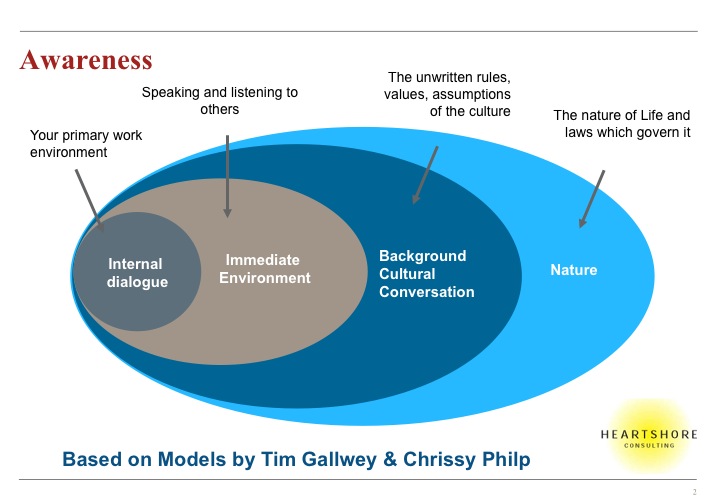
So how does this all connect to doing a session for the Client Relationship Management team at a client?  I was there running a session on Appreciative Inquiry for the team, looking at how they could work in the current environment to support the leaders of the business in working with clients.  I started by getting them to look at the reality of the situation through 4 different lenses.  This is adapted from a model by Tim Galwey as below:

Slide02

What Tim observed was that when we interact with the world around us we are operating in 3 main contexts which overlap and interact with each other.  The first is our individual world, where our internal dialogue is running all the time, trying to make sense of the world around us (in practice there is more going on at this individual level as it is also informed by our emotions, our senses and our intuition.  It is only through this individual level that we are able to process changes in the other environments or change and adapt.  The Immediate Environment is all the people we are interacting with day to day who provide us with awareness about the world immediately around us.  The third circle is the broader environment of all the unwritten rules, values and assumptions which permeate the broader environment.  Since these three contexts provide information which is intangible it is difficult for us to create accurate pictures of them and they are also continually in flux which means that we are always updating these pictures or at least, we need to in order to be able to relate effectively to our environment.  Tim Galwey’s point was that the greater our awareness of these three environments the more skillfully we are able to respond to them.  It is obvious that if we are unaware of something then we cannot respond to it.  The last sphere is Nature and this comes from an essay by Chrissy Philp where she put forward a model similar to Galwey’s but which included this sphere of Nature and a further sphere of Cosmos beyond Nature.

Since the sphere of Nature is already challenging enough in a business environment I have not expanded the model to include Cosmos thus far!  For me, the way I have interpreted this sphere of Nature is in terms of examining the nature of life and the nature of the three other circles, ie. the nature of organisations and cultures, the nature of other people around us and our own nature.  The more accurate our picture of these the more effectively we are able to interact with them.  There is an added dimension to the nature part for me, which is to try and determine those deeper laws or cycles which are not as changeable as cultural and personal phenomena.  One example I tend to use is the fact that it is in the nature of organizations and cultures to be messy and imperfect.  Once we recognise and expect organisations and cultures to be messy and imperfect we might chose to act to make aspects of them less messy or imperfect but we do so without the false expectation that we can permanently affect them or change their nature.  It is the same with people around us: once we accept their nature we are no longer attempting to mould them into a shape we believe they should be and instead are free to work with their nature.  This is the key to the Nature level for me; once we understand the nature of something we can work with its nature rather than wasting our energy fighting against its nature.

And still, in typically Sagittarian style, I haven’t got to my original point, but am still busy on tangents to fill in the threads of the story!  What was it then that struck me at the workshop I was running for the Customer Relationship Management team?  What struck me was that the focus on relationships in business these days, particularly in an environment where business is tough and winning work has taken on a greater premium, might well be part of an evolutionary shift, a shift towards putting the individual human being first and the technical elements of the service you are providing second.  That is, that we are learning to value other people as human beings first and then to consider the transaction we are having with them as secondary or in service to the vehicle of the relationship or common humanity.  Thus the role of relationship managers and sales people, is actually to help people learn to be interested in others and put the relationship and interaction first rather than seeing them as objects that serve our transactional commercial needs or vessels for the fulfillment of our need to be an expert.

Whilst I recognise that, at this stage, much of the focus on developing relationships in business is still somewhat mechanical and self-serving, it is nevertheless an evolutionary step from the previous focus on putting the transaction first and the relationship or human being second.

Is it possible that we are evolving to a point where all our interactions with each other will be closer to Ram Dass’s room mates approach, where the various talents and practical skills that we have are in the service of our common humanity?  It puts me in mind of one of my favourite series, Star Trek, designed by Gene Roddenberry to act as modern parables.  In Star Trek, we get a picture of what an evolved human race could look like, where each individual still brings their individual talents to bear and plays their role but in the service of a common humanity and with a respect for the humanity of each individual, and with the attitude towards alien species, a respect for life itself.

I was even intrigued to hear a view voiced among the Customer Relationship Management team that there had been too much focus on profit and this had been dangerous and damaging, that the current environment was a re-balancing, forcing individuals to respect the relationship (and thus individual).

Could we envisage a future where everyone; the plumber, the lawyer, the shop assistant, the car salesman meets you as a fellow human being first and then puts their expertise in the service of that common humanity?  I think in many instances we already do this; one has only to look at the response to disasters such as the Tsunamis in Asia and Japan to see our ability to put our common humanity first. Yesterday I was going through security for the Eurostar at St Pancras and the man at security took time to smile and talk to me as a fellow human being.  The effect on my heart and his stayed with me and passed on to others I met like a ripple in the pond for some hours.  Perhaps if we evolve beyond money we can redefine this as “profit” a contribution to our common human wealth – the wealth of our hearts.

Back to the CRM team and my earlier point about how to find a job which contributes something to our common humanity. Given the difficulty of the current environment with the pressure, fear, emphasis on profitability, it is difficult to feel that there is any evolution; things feel tougher and less inspiring; a return to the material realities of cost-cutting and treating people like objects.  Yet, see this as a person challenge not to be overcome by fear and an “everyone for themselves” survival mode and rather as an opportunity for intense learning about ourselves and how to remain true to ourselves and transform these negative emotions and a huge opportunity to contribute to our common humanity and evolution appears – in fact almost the perfect one.  In Star Trek, there are constant complex and difficult challenges which look black and incapable of solution.  What I love about it is that these challenges are transformed into deep learning which advance us as a race (and Universe).  So it is not a question of searching for a worthwhile or valuable job but searching for how we can transform ourselves and what we do to be of value and purpose.  To paraphrase the peerless Don Juan Mateus in the Carlos Castaneda books “It is only when our backs are against the wall that it brings the best out of us and personally I wouldn’t have it any other way”.

Leave a comment

Filed under On Life the Universe and Everything

The Myth of Limitless Potential

I have to start this blog by admitting that I do not know what potential is.  So perhaps my title is unfair as a claim.  Since I do not know yet what I am going to write I am going to let this blog emerge and fulfill whatever potential it has!  My own experience of working on potential owes much to Tim Galwey’s work.  Tim Galwey coined a formula: Performance=Potential-Interference.  His point was that in order to realise potential we need to reduce interference.  Yet what do we mean by interference?  Tim Galwey’s view was that it was the doubts, fears, limiting beliefs that we hold that cause interference.  I would largely concur with this although I would add to it, from my experience of working with Chrissy, and include inaccurate assumptions or mind-pictures about ourselves and the world around us.  Tim Galwey observed that much of interference, or doubts, fears etc. come from a judging voice.  Tim Galwey called this self one, as opposed to self two.  Self one is the internal conscious voice which judges and criticises us and tries to take over our actions and complete them consciously.  Coming from a sporting background Tim Galwey was looking at this particularly in the context of sport, where when the conscious mind tries to take over doing something physical it simply gets in the way since it is completely incapable of calculating the complex variables involved in even simple actions.  It is the same in everyday aspects of life; when we are fearful of being judged, our mind chatter takes over and tries to consciously relate to people.  The result is a very wooden, or forced way of being.  I notice that generally when things are going well in any given interaction with someone, we do far less judging of ourselves and them and far more noticing.  When they are going badly we do a huge amount of judging.

So far, so good, however, I notice that this has led to a current vogue of believing that we have limitless potential if only we could get rid of this judging voice; that we can become whoever we want to be, if we can overcome our limiting beliefs and be more confident.  Advocates of NLP seem to be particularly susceptible to this belief.  Whilst I have worked with some very wise advocates of NLP, it nevertheless seem to be a popular myth for proponents of NLP who seek to be free of limitations or weaknesses in anyway.  Recently friends of mine were advocating (somewhat humorously) that I listen to the wisdom of Arnold Schwarzenegger on the internet and he is perhaps not untypical in that one of his mantras was not to listen to others and believe in your ability to achieve the impossible.  The celebrity lifestyle that captures many of our global projections is infested with this notion that, if only you can overcome your limiting beliefs, you too can become whatever you want to be.

One of the values of astrology is that it gives us an objective framework for understanding our personalities and therefore our limitations.  Recently, I was on the Eurostar going to Paris and I was held up 5 mins outside Paris.  Given that I had left at four-thirty in the morning to try and get to Paris as early as possible to see a client this was frustrating since I was already not going to manage a full session.  I consulted the astrology programme on my phone and was amazed to find that the ascendant was exactly between the Neptune-Chiron conjunction.  The message that came over the tannoy was that the train in front had “hurt” something on the line and they were now investigating.  This could not have been more clearly described by Neptune and Chiron rising especially since over the coming minutes there were confused announcements about what was happening and how long the wait would be.  Neptune-Chiron was also square Jupiter in Gemini – ruling travel to foreign countries but also information about foreign journeys on the train network.  The Neptune-Chiron was square my Mercury in Sagittarius ruling travel and foreign countries and also the confused emails I was sending to my client having to correct earlier incorrect ones based on the confused messages from the train staff.  At the same time Mars in Aquarius was square Saturn in Scorpio hence delays due to having “hit” something.  As it turned out, it had been a suicide – sadly apt for Saturn in Scorpio trine Chiron and also the Neptune-Chiron rising.  The Saturn-Mars square reflected what turned out to be a very long delay of over two and a half hours.  There were further aspects which linked to my own chart, but the thing that struck me most was how perfectly everything fitted the chart and the relationship to my own chart.  It was a moment of awe at the sheer accuracy of Astrology.  What I realised was that the problems we have being able to see clearly what a chart is showing or to divine it’s meaning are not down to the inadequacies of Astrology but rather to our own limitations in understanding.  Most astrologers experience that moment when it is like the veil is drawn back and we see everything the chart is saying with a sense of wonder and awe at how accurate and precise it is.  I have experienced a similar phenomenon with the I-Ching where the hexagrams and lines are so absolutely apposite that it is quite stunning.  Indeed, I find as I study it more and learn from others, it becomes clearer and clearer.  I even have occasions when I am talking to someone about a line or hexagram and they throw that line or hexagram.  I also keep a diary of what I throw in the I-Ching and on occasion look back on what I have thrown.  Each time I have done this, it has made me aware of the fact that whilst I was unclear what the I-Ching was saying at the time, with hindsight it could not have been clearer or plainer.  These events make me realise that this accuracy exists all the time but is limited by my own inability to see clearly.

If this is true and tools like Astrology and the I-Ching can reflect, down to pinpoint accuracy, what is going on, then that suggests that our lives are not limitless in potential, as the the I-Ching itself says:

Unlimited possibilities are not suited to man; if they existed, his life 
would only dissolve in the boundless. To become strong, a man's life needs 
the limitations ordained by duty and voluntarily accepted. The individual 
attains significance as a free spirit only by surrounding himself with these 
limitations and by determining for himself what his duty is.

Charlie is a twenty-four year old who is autistic.  He came to my wife five years ago to work with horses.  Since then Charlie has, with help, bought his own horse, Spirit, and started to do his own demonstrations and talks, including talking to the Education sub-committee about autism.  He has also written his own book which he is looking to publish.  Recently Charlie was asked by his great hero Monty Roberts, the Horse Whisperer, to talk at a demonstration with Monty.  Charlie was ecstatic and when it came to the show he took over, which went down well with everyone.  Monty and his main representative in the UK, Kelly Marks, suggested Charlie could work further with them.  Charlie is also an ardent facebooker with over a thousand friends.  Everything on the surface seems great, people on facebook continually encourage Charlie with his plans and ideas, telling him to have confidence in himself, not to listen to others who doubt him because of his autism and take his side unstintingly in all his problems or difficulties.  The difficulty with all of this, is the impact on Charlie has been to spin him into a big black hole.  Carried away with his dreams and plans he became agitated and angry with the limitations of his current situation and very disturbed indeed.  He wanted to throw away all that he had actually achieved and was feeding himself on a diet of imagined future fame (working with his hero Monty) and prosperity which did not match the reality of his situation or capability.  I have noticed a similar, paradoxical element in coaching others and my own development.  It does not seem to be that we develop our potential by bursting through limitations but rather by accepting and coming to terms with the reality of who we are and the limitations of our nature and situation.  For Charlie, understanding his own Icarus like nature, his own tendency to extreme anger and frustration and accepting the reality of his own nature and autism seem to be more productive in terms of his development than being told that he can break through or break away from this.  I think that are our limitations in terms of context and personality are perhaps the key to developing our potential rather than the obstacle.

I have always considered the Icarus myth to be concerned with fulfilling our potential.  The flight from being locked up in a tower – at first we are blind and have little knowledge or ourselves or the world around us, the flight away from the tower symbolises our journey towards knowledge and wisdom and fulfilling this potential – we want to fly, to grow, to expand.  Too much focus on the Sun (the vision of our own potential and all we want to and think we can become) derails our journey and causes an uncomfortable collision with the reality of the ground (or sea) below.  On the other hand, not to aspire or to have some vision of becoming more than we are, means there is no movement and we cannot fly, we are stuck in the current or past, unwilling to move beyond our present position.  Whilst the myth focuses on Icarus, perhaps the more interesting character is Daedalus whose instruction to Icarus is not to fly too close to the sea, lest the foam from the waves should wet the feathers and drag him down nor too high lest the heat of the sun melt the wax binding his feathers.  We can see that too negative a view of ourselves holds the possibility of drowning in our fears and negative emotions, however, too glorious a view of potential and too much praise holds the danger of melting the solidity of that groundedness in reality which holds us together.

The I-Ching talks about how to develop our potential in Gradual Progress, it says:

A tree on a mountain develops slowly according to the law of its being and consequently stands 
firmly rooted. This gives the idea of a development that proceeds gradually, 
step by step. The attributes of the trigrams also point to this: within is 
tranquillity, which guards against precipitate actions, and without is 
penetration, which makes development and progress possible.....
  Within the personality too, development must follow the same course if 
lasting results are to be achieved. Gentleness that is adaptable, but at the same 
time penetrating, is the outer form that should proceed from inner calm.
  The very gradualness of the development makes it necessary to have 
perseverance, for perseverance alone prevents slow progress from dwindling 
to nothing.

	THE IMAGE

	On the mountain, a tree:
	The image of DEVELOPMENT.
	Thus the superior man abides in dignity and virtue,
	In order to improve the mores.

The tree on the mountain is visible from afar, and its development 
influences the landscape of the entire region. It does not shoot up like a 
swamp plant; its growth proceeds gradually. Thus also the work of 
influencing people can be only gradual. No sudden influence or awakening 
is of lasting effect. Progress must be quite gradual, and in order to obtain such 
progress in public opinion and in the mores of the people, it is necessary for 
the personality to acquire influence and weight. This comes about through 
careful and constant work on one's own moral development.

To develop, it is a question of self-knowledge rather than just aspiration; the more we know ourselves the more our development is in accordance with our own nature and successfully rooted in our own being. This requires that we know ourselves, including the limitations of our own nature and the nature of our environment.  Like most wisdom, I have found it bafflingly paradoxical; that inquiring more deeply into our own nature gives us insight into the nature of others and our environment which allow us to see possibilities and opportunities to grow and develop and achieve our potential.  This does not then mean that we should dismiss or deny limitations but rather embrace them as part of our journey into understanding our own and others natures and differentiating real limitations from self-constructed ones in order that we can accept these limitations without necessarily being dominated by them.  After all, like Icarus, seeking to fly beyond our limitations or become limitless is really to be dominated by a fear of them.


2 Comments

Filed under On Life the Universe and Everything

In defence of Chiron

Most of the material about Chiron rightly focuses on the pain and suffering that Chiron causes, on the wound that it represents in our personality.  It is the part of our life that will not work, or causes us continual pain.  I do not demur from this view or from the notion that Chiron is connected to the painful aspects of our life, but I would like to examine its attempts to bring something of value to our lives beyond just the grace of suffering and in this sense I want to act as defence counsel for this small planetoid.  I respectfully submit, my lord, that this planetoid, due to its diminutive size and reputation for scapegoating has been the victim of some scapegoating itself and being a small object easily picked on, I intend to stand up for it.  Rumours that I have Chiron closely square my Sun and Ascendant and therefore have a vested interest in defending this planet are completely without foundation; it is an act of pure compassion on my part.

Chiron in myth was the trainer of heroes and I notice that, while this is often mentioned, it is not always focused on in terms of what this tells us about Chiron.  In myth, Chiron was immortal and this was part of the central tension inherent in his myth, in that when he is accidentally wounded by his friend and student Hercules, whose hydra poison tipped arrow brushes his thigh, he is in agony from the wound which cannot be healed (due to being the hydra’s poison) but from which he cannot die because he is immortal.  We can all identify with Chiron in the sense that there is always some part of our lives that does not work for us, that causes us pain or fear, and which we worry away about, like a nagging tooth pain without ever resolving it.  I was recently looking at the chart of a friend who was in the midst of a relationship dilemma.  She was in her early fifties and involved in an on-off relationship with a younger man.  Her dilemma was whether to stay or leave someone who appeared to be so difficult to relate to.  She herself had given up altogether on relationships for many years because they were so difficult.  Her focus was on the difficulties in the personality of this man and the dilemma of whether to give up or not was almost overwhelming her.  Yet it was clear standing back, that whichever way she turned relationships was where her black hole game was playing out.  They were not going to be easy in her life.  Whether she chose the pain of loneliness, because relationships were too difficult and painful or whether she chose relationship and accepted they were painful and frustrating was the real choice.  In typical Chiron terms, the blame went on the other person.  Why was he so difficult and why was she wasting her time and yet she could not let go either.  The presentation of herself as the victim in the story invited all her friends to tell her that this man was worthless and she should give up on him but this advice didn’t resolve anything.  On this evidence, Chiron looks guilty as a bringer of pain and irreconcilable difficulty.  Yet if we look more deeply, this man, who entered her life and whose Hydra like poison was causing her continual pain which she could escape, was really her training about relationships.  This was someone whose role involved coaching people in leadership positions.  Really it was key to her learning and her teaching of others.  This man reflected many of her own personality traits and the only solution was to work on herself and give up blaming him or thinking she could change him.

I am conscious that the part of Hercules in the myth, is rarely focused on, but I wonder if it is worthy of more exploration?  When Hercules injures Chiron it is not intentional.  This seems pivotal and traditionally the focus is on the unintentional nature of this incident, it is just an accident and that is as far as Hercules’s role goes.  Yet I wonder if there is more to it than this; what is the Hydra’s poison? And what is it about Hercules that causes him to be the person transmitting it?  Everyone has presumed Hercules innocent, yet looking at the detail of the myth, Hercules’ arrow tips are poisoned and on a symbolic level arrow tips seem quite clearly Mars and therefore are redolent of competition; Hydra’s poison has more of a Pluto quality and thus power and jealousy rear their heads.  Looking further, Hercules’s poisoning of Chiron is a direct consequence of one of his greatest triumphs.  This is a familiar thread for me.  Having the Sun less than half a degree from being exactly conjunct the Ascendant, I am a big personality and with Mars in the first in Capricorn trine Pluto-Uranus a competitive one too.   It was a shock to me to discover that this big personality could wound other people who felt small by comparison.  I did not feel like a big personality (I have a Cancer moon) but this did not stop my personality making other people feel small in comparison.  Thus they were wounded by personality, especially when I was doing a good job of shining brightly and confidently and so they would poke me, anticipating that my big personality needed a barge pole to poke with to get it to notice, whereas with my Sun square Chiron in Pisces it needed only the lightest of touches.  Thus for my friends it was painful to have me around at times and for me, it was painful too.  I can’t help feeling that a similar thing is at play in the Chiron myth.  There is no-one to blame but everyone ends up hurt. It is an accident, which no-one intends.  That is the most frustrating part of the myth, that Chiron cannot really blame his friend Hercules, yet Hercules’s brilliance in the world (conquering the Hydra), does wound his friend.  Yet what is the result of this wounding?  The result is that Chiron has to deepen, to evolve and learn about himself.  So his friend is both the source of his suffering and also his evolution.  There always seem to be people in the world who just by their existence make us feel inadequate in some way, and yet in most cases it is not intentional.  Somehow it this which makes it so unfair, that really no-one is to blame and yet nevertheless it is painful.  Our parents, doing their absolute best and loving us enormously somehow manage to wound us.  They don’t mean to but they do it nonetheless.  Can we really blame these poor human beings who were doing their best? It is the inequality of life which seems so unfair; some are beautiful, some are talented, some are rich, some intelligent, the list goes on and on.

Yet, there is something curious at work here.  This black hole game, where life is imperfect and full of painful situations is also key to our evolution and growth.  This is something I have detailed before which is described by Chrissy Philp’s book about the black hole game, One Way of Looking at Man.  Even more than this though, Chiron is somehow critical in bringing us together.  Expressing our pain and vulnerability and the aspects of our lives that don’t work, somehow tempers the discomfort of solar energy, where everyone is shining.  Who likes the individual who seems to have it all, or has no vulnerability?  Somehow we identify with vulnerability and imperfection, it brings out our empathy and compassion for others.  Where would stand-up comedy be without the collective recognition of our neuroses and inadequacies?  Hearing comics reflect our own neuroses brings a relieving laughter that brings a sense of unity about the state of being human.

This tiny planetoid, situated between Saturn and Uranus mediates the connection between the individual and the collective.  We cannot truly enter the realm of the gods, we are none of us immortal; we are all subject to decay and death, yet somehow this is the point and perhaps the very thing which does make us immortal – our acceptance of these painful limitations (Saturn) which brings us an enlightened perspective (Uranus).

Many astrologers now give rulership of Virgo to Chiron (and according to Chrissy Philp, the asteroid belt and perhaps Kuiper belt as well – this would certainly be fitting in terms of the wounding and Virgo’s constant war to bring order to their environment without ever fully succeeding – the asteroids never quite got cleared up into a planet!) and this fits with the notion of neuroses and the imperfection/perfection axis.  Yet it also suggests another element of the Chiron myth, that of modesty.  Hercules the great hero returns in triumph from defeating the Hydra, only to wound his best friend.  How must he have felt?  His greatest success turns into shlick in his hands.  He must have felt dreadful.  Oh no, now both friends feel awful, Chiron for the pain he feels and Hercules for having unintentionally hurt his friend.  Ow, ow, how awful.  Those who have been wounded by painful misunderstanding will recognise that the only way out of this dilemma is profuse apologies, tears and genuine empathy for each other (as the I-Ching says Men bound in fellowship first weep and lament, But afterward they laugh.  After great struggles they succeed in meeting).  Somehow this messy painful process also has unexpected benefits.  We are currently on a ski-ing holiday in France with friends, including many of my son’s friends and some of my daughter’s.  One of the grown up friends of our son Luke, said that he thought we were the most dsynfunctional family he knew and this hurt Luke particularly and the rest of us, an argument followed between Luke and Rafe and then eventually Luke and I explained the real issue was that we felt hurt.  Rafe instead of continuing fighting with Luke, gave him a big hug and then each of us a big hug in turn.  None of us could help smiling and laughing and all our hearts opened.  Rafe is a big personality and apt to make tactless remarks or simply to be overwhelming and boundary less – he has Mars conjunct Jupiter in Libra in the first house.  Yet he is brilliant also at knowing how to bring everyone’s hearts together and he explained that he has been with us so much as a family that he feels part of the family and that with us, our dysfunction is out in the open and expressed.  These experiences of overcoming hurts and misunderstanding deepen friendship and often the outcome is laughter and a sense of warmth and open hearted goodwill when it is resolved.  Laughing with our friends about painful and embarrassing mistakes is one of the ways of sharing mutual vulnerability and absurdity which brings down barriers and cements the sense of goodwill.  All the best storytellers tell stories against themselves and this often grants us access to new groups.

Chiron also seems to play a critical role in teaching and learning.  My own learning has been mostly influenced by storytelling, that of my friend Chrissy and also such people as Milton Erikson another quite brilliant storyteller and Ram Dass, the ultimate raconteur.  Yet, it is not just that these people tell stories; it is the stories that they tell and what these stories contain.  In the Carlos Castaneda books, particularly Tales of Power, Don Juan relates stories to Carlos full of power.  What he meant by power in this sense was stories with the power to transform our understanding.  They were critically stories about learning.  The key to all these storytellers is that their stories are about their own solar process of clarity and enlightenment gained through the mistakes and difficult experiences of their lives.  It is their ability to use these stories creatively which allows them to teach others to fulfill their potential and become heroes (full expressions of themselves).  The point about these stories is that they are full of the vulnerability and reality of human life yet redolent with the process of having turned these experiences into wisdom.

In Greek myth heroes such as Oedipus were undone by a fatal flaw, Hardy continued the theme in his novels.  There was always the sense of misunderstanding and human flaws piled atop each other to create an inevitable denouement.  It is always Hubris routed in the individual’s personality which brings their downfall.  In Tess of the D’Urbevilles Angel Clair cannot accept that Tess is not the virgin of his dreams, in Oedipus, his rage and ambition cause him to kill his father and sleep with his mother.  Yet it is intriguing to then watch what happens to these characters following their demise.  Oedipus is consulted for his experience and wisdom despite his downcast status, in Hardy, Angel Clair period of separation and reflection causes him to understand his flaw and return to Tess.  They may not be happy stories in terms of events but they are stories about suffering turned into wisdom.

At a personal level, with my Chiron in the second house, I was struck the other day by a response from someone to a comment I made about my luck that my work has continued to come despite the economic downturn.  They found it amusing that I should suppose it was good luck and not down to ability.  A sense of neurosis about work drying up has been a fairly constant companion which I have played with throughout my career owning my own business and before that I was nagged by a sense of being unemployable beyond the job I was in.   Yet, I am conscious that it is luck.  While it is a neurosis on my part there is also a truth to my neurosis that has its value.  In this sense I think Chiron has a role in keeping us safe from hubris, in staying modest (a very Virgoan virtue).  Our difficult experiences, our neuroses have their value in preventing us from taking our good luck or our solar shining for granted.  Had Oedipus been more neurotic and had more modesty and less confidence he might not have so impulsively killed his father and married his mother.  At its best Chiron brings humility which allows us to shine without the hubris and arrogance which brought about Icarus’ demise.  Our current vogue is to see our neuroses and frustrations as the elements getting in the way of fulfilling our potential.  Yet, what if they are the key to training our solar energy to shine without self-combusting, to temper our immortal side with the humanity and modesty of mortality?

Thus I rest my case for Chiron, a poor misunderstood planetoid, who isn’t really meaning to hurt anyone but rather to teach them.  His sacrifice in the end to release Promotheus, tell us about this relationship between the Sun and Chiron.  Chiron’s modesty and willingness to suffer, released Promotheus from his continual pain (in the end, if we can see that our suffering is key to our evolution we transform it into something which nourishes and enlightens us allowing us to fulfill our creative potential).

5 Comments

Filed under On Life the Universe and Everything

Further thoughts on the laws of probability and their impact on our approach to life

Having had a series of stimulating email exchanges with my friend Ali since my last blog on probability, I am venturing out again, despite the possibility of a fatal ambush from him!  What it has prompted to think about further is what the impact is of the concern I raised about probability.  I have also had time to refine my thinking about probability and tested it out with a client who is paid for his expertise in Economic statistical modelling.  He admitted he could find no flaw in my reasoning – carefully staying neutral on whether he actually agreed with me or not!  What I am concerned with is the fact that the laws of probability state that when you have a choice or roll a die, there is a definite and indisputable level of chance that a particular outcome will occur.  So, as per my last blog, if you roll a die, you have a one in six chance that you will roll a particular number, eg. six.  Now, this is not stated as an approximation or even as being probable.  It is stated as absolute fact.  It is so much part of our paradigm of thinking that we do not even question this, it seems so self-evident that we have a one in six chance, it would seem perverse to question it.  However, as Edward De Bono has pointed out, creative thinking comes not from thinking logically from your existing premises to arrive at a new conclusion or insight, but rather from thinking asymmetrically, ie. changing the perspective or paradigm from which you are thinking.  This ability to “switch” our perspective we describe as “insight” – in that it is to do with seeing something (internally) in a different way.  More recently this has been associated with the parietal lobe in experiments on the brain.  This is the section of the brain that my friend Chrissy’s model associates with Mars.  I have long considered Mars (or Aries) to be the seat of creativity.  The reason for this is again connected to Edward de Bono’s work.

De Bono suggested that our modern thinking tools are dictated by the Greeks and in particular by Aristotle, Plato and Socrates.  In his view they created our first thinking tool – critical thinking.  The purpose of this tool was to eliminate everything that was not the truth and thereby ascertain what was the truth.  De Bono felt that whilst critical thinking (Black Hat thinking according to his model) was valuable it had a flaw which was that it was not creative and that, whilst it could establish what was not the truth, it was not very effective at establishing what was the truth or generating new insights or understanding.  He described this type of thinking as logical negative thinking.  What he observed was that in any exploration of a subject, exploration and insights would rise to a certain point until individuals became attached to their position, at which point they would lock into their viewpoint and the person who was the most competitive and had the greatest ability to employ Black Hat thinking would generally win.  This did not necessarily mean their idea or position was any more valuable but simply that they were better at picking holes in other peoples, either because they had more motivation (competitive drive) or were better at logical negative thinking (what is generally measured as IQ).  In many cases, he observed, the result of this approach was a stalemate if the opponents were sufficiently good Black Hat thinkers and sufficiently competitive.  Thus for the Greeks, dialectical thinking, based on knocking down the other person’s argument, became prevalent and is still part of our political and judicial systems to this day.  Thus most of us realise that in law courts, the focus of lawyers is less on finding the truth and more on beating each others arguments, similarly in the parliaments, there is often little genuine exploration of the truth and more focus on opposing and trying to pick holes in each others points of view.  With this in mind, De Bono invented a word – po.  A po was a “provocative operation”.  It’s purpose was to block or prevent the current assumptions and paradigm of thinking from applying.  Thus a provocation operation might be to suggest something which was manifestly ridiculous but might lead to new insights (Green Hat or creative thinking).  One of the examples of this was to explore the idea of putting the cockpit on the bottom of a plane instead of the top.  Immediately our mind grabs for the Black Hat to point out that this is an absurd idea and it is dismissed.  However, if we suspend our Black Hat thinking and instead use what De Bono called Yellow Hat thinking – exploring an idea by looking for the logical positive – the benefits, value and feasibility of an idea, we arrive at a very different place.  Suspending the problems, difficulties and objections to the cockpit being on the bottom of a plane, we come up with the fact that it would be easier for the pilots to see the runway unobscured by the nose of the plane.  It would also mean that the pilots could see the wheels of the plane as they make contact with the runway.  Suddenly, our assumptions, based on the familiar practice of placing the pilots on top of the plane begins to shift and our mind opens to exploring the genuine advantages of placing the cockpit elsewhere on a plane.  We are in open-minded exploration which will no doubt lead to new insights and ideas.  We might then apply black hat thinking again to our new ideas to make sure we understand the difficulties or problems we might encounter with them.

What De Bono recognised was that it is the mind’s ability to think asynchronously which allows us to make breakthroughs and that this required a provocative operation to shock us into moving away from our current habit of thinking.  The I-Ching calls this Shock (a hexagram which correlates on Chrissy Philp’s model with Mars).  Critical thinking is valuable because it prevents us from falling prey to all sorts of distorted and unfounded thinking and it foresees the problems and difficulties associated with an idea.  On the other hand it is also dangerous because it cannot break away from the premises of our current assumptions to open-mindedly explore a new angle.  This brings me to De Bono’s Red Hat.  De Bono identified another mode of thinking and he called this Red Hat thinking, this type of thinking was gut feeling or intuition.  De Bono was astute in noting that much Red Hat thinking posed as Black Hat thinking.  For intelligent people saying that they do not like an idea – which might imply emotions like jealousy, close mindedness or competition – is not comfortable so they dress up their Red Hat thinking with apparently Black Hat arguments.  Yet, the purpose of their Black Hat thinking is not to genuinely raise problems or difficulties but simply to try and destroy the idea because they do not like it or it does not fit with their view.  To counter all of these problems De Bono invented the Six Thinking Hats in order, primarily, to get people thinking in parallel rather than in opposition.  Thus when a new idea is presented, everyone thinks together about the logical positive – the benefits, the value etc. as well as declaring their gut feelings, adding new ideas to it (green hat thinking) etc.  This bypasses the stifling of new insights and ideas created by oppositional thinking and allows for greater open-mindedness and new perspectives.

De Bono also noted that our tradition of thinking since the Greeks has been predominantly Black Hat.  If you think about Universities, you can see that traditionally one studies Literary Criticism, Art Criticism etc. There is no emphasis on creating art, literature, etc. in the traditional academic institutions.  Thus the most intelligent people tend to be those most skilled at deconstructing the ideas of others rather than creating.  Creative people tended to avoid universities or fail at some point along the academic system.  Interestingly this is beginning to change but in the UK it is the former polytechnics who are leading the way in offering creative courses.

So why have I devoted so much time to detailing De Bono’s insights on creative thinking?  The answer is no doubt obvious to anyone with psychological insight.  It is that I am putting in place a defensive justification for my ideas which is constructed in such a way as to render anyone who tries to criticise my ideas as petty or unenlightened and probably both.  Indeed even to venture criticism of this defence is to fall into the trap of being seen as petty and competitive.  Sadly, I suspect there are probably such clever players of this particular game that they will still outwit this defence so I will give up at this stage and get on with explaining my idea.

My idea is to create a po to examine probability as my perspective from another paradigm – that of the I-Ching and my own learning about Life – suggests that Life does not operate on random chance and I therefore want to provocatively throw the assumptions behind the world view of life as random, meaningless chance into the air.  I also think I have good grounds for doing so (one thing I have never lacked is the arrogance to challenge prevailing views long crafted and researched by experts who know a zillion times as much as I do about a given subject.  I like to think of it as an endearing quality, strangely others seem to think of it in quite different terms and are often incadescent with offence at my perceived insolence and temerity.  I have still to fathom why, when I am being so irreverently provocative about people’s deeply cherised beliefs, some people seem to react so badly – it is a mystery!

So here we go.  Probability states that it is a fact that when rolling a die you have a one in six chance that you will throw any particular number.  Yet, while this is self-evidently true, so was the fact that the earth is flat.  I think that this law of probability might be an assumption, ie. it might not be true.  To prove these laws, people would look to research and in particular statistics.  But I do not think that statistics back up this fact, far from it.  In small amounts of throws, statistics suggest that the distribution of numbers will not come close to conforming to this distribution (one in six chance of any number).  There might only be a 10% confidence level that this will be the case.  Even with multiple throws that take you to a 99% confidence level, it still means that 1% of times the data will fall outside this distribution.  It is only at a hypothetical infinity that it conforms perfectly to this distribution of a one in six chance for each number.  So in practice, you do not have a one in six chance, nothing so certain or precise.  It could vary enormously, capriciously and unpredictably so (ok, ok, so I am attributing human qualities to non-human objects, but this is a po, so I am allowed to – ha! ha! and also who made the assumption that dice and the rolling of them do not have human consciouness involved?).  It reminds me of the conflict between Einstein’s theory of relativity and quantum mechanics.  The quantum world does not appear to conform to the Einstein’s theory and yet the Einstein’s theory works very effectively for everything beyond the quantum world.  Thus despite the strange happenings at the quantum level, when you aggregate all of them at a sufficiently large level, it all seems to conform to our expectations – which I am grateful for or I wouldn’t be able to write this article.  If this is true also of rolling die then it would mean that in large quantities of dice rolls a familiar pattern of distribution tends to get stronger but beware if you think this tells you what is going on at a singular level or in a small set of data.  From my perspective, it strikes me that life has plenty of wiggle room to avoid our pre-concieved notion of a world based on uniform, knowable and predictable rules of chance where all outcomes are equally probable over time.

Why is all this of any relevance to our daily lives?  For me it is relevant because I think it is informing our view of the world and causing us to fall into some dangerous traps.  One main one I see is the fear of missing the boat.  This fear dominates bright, ambitious, professional people and particularly has begun to predominate when it comes to sales.  People in professional services firms see themselves as competing for a limited market of clients.  The logical argument, based on this paradigm of chance, is that the more people you meet and make contacts with the greater the chance that you will make a sale and get clients.  This has led to the phenomenon of “networking”, the idea being, the greater the number of people I network with the greater my chance of being successful.  Since the world according to this paradigm is random and without design or meaning, then this probability approach prevails.  Yet, this approach leads to a paranoia, deeply prevalent, of missing the boat.  Since the number of potential contacts (and clients) is limited then if someone out there is meeting more people and has a larger network, they are likely to get more of the clients and I will get less.  Oh no, oh no, I had better push harder and meet more people, keep up, keep up they are going to overtake you….!

My experience is that this premise is false.  When I ask people where their work comes from, they invariably tell me that a large proportion comes from sources that they could not possibly have predicted nor does it always relate directly to any efforts they have made to network or contact people.  When I set up my own company, I wanted to put what I had discovered into practice, so I avoided doing any networking or selling to see whether the work and people would find me.  This allowed me to relate to people because I wanted to and liked them not because they were one of my “chances” or die rolls.  I find I can tell when I am one of someone’s die rolls and there is nothing more off-putting.  Taken to it’s extreme we all suffer from the assumptions behind this paradigm in terms of junk and spam emails, phone calls from call centres trying to sell you things you do not want etc.  Yet, we have created this world, based on our paradigm that all outcomes are based on probability which is based on chance – a meaningless, all possibilities are equally likely, universe.  Critically this is a universe where there are also no consequences to our actions.  How could there be if life is random and based on chance.  If the chances are there will be no consequences, why not do it?

My own experience refutes this notion.  My colleagues who have run around networking with literally hundreds of people have been no more successful in getting work.  I am always amazed at where my work pops up from – some is predictable, some comes from places I could never have predicted.  Yet, it remains remarkably constant and at a level that suits me and has done so for some nine years.  When I observe the experiences of my clients lives I see that the black holes they fall into are brilliantly constructed to surround them with people who reflect back to them their own personality.  I also notice, that when I think something, or I hear others say something, it regularly comes to pass (although often in a form that provokes them to examine if they really want it!).  I am not suggesting that we do not need science, but rather that we need a grand theory of everything.  Ie. we need a theory which brings together the different modes through which we understand the world – our rational mind, our intuition, our feelings, our senses, our ability to make meaning etc. etc.  I do not think that the grand unifying theory will come from our existing paradigm, indeed like most breakthroughs, I suspect it will come from a place which is wonderfully asynchronous with our current prevailing view and no doubt will act as a po to this prevailing paradigm.  I don’t suppose it will explain everything but I think, given that we are entering the Age of Aquarius it might marry together all these elements in a conceptual framework.  My own view is that we already have it but sadly this thought is so preposterous it might take us hundreds of years to accept it.

1 Comment

Filed under On Life the Universe and Everything